


An Exceptional Minimalist Collection Auctioned at Christie’s
Updated: May 13

This May, as the art market gathers in New York for its pivotal spring auctions, Christie's is bringing to the block what may well be one of the most visually compelling private collections of Minimalist art ever assembled. Titled Defined Space: The Collection of Henry S. McNeil Jr., the sale will take place on 20 May 2026. Key highlights include a 1969 “stack” by Donald Judd, widely considered the most important example ever to come to auction, estimated at $10–15 million and potentially record-setting, and a landmark fluorescent work by Dan Flavin entitled the diagonal of May 25, 1963 (to Constantin Brancusi). The collection also includes major works by Sol LeWitt, including one of his wall drawings—a large-scale chromatic composition developed through conceptual instruction—and one of his incredible hanging structures, as well as beautiful sculptural floor works by Carl Andre.

Henry S. McNeil Jr. came from the McNeil pharmaceutical family, whose wealth was built through McNeil Laboratories, the company behind the commercialization of Tylenol. He was born on August 23, 1943, in Plymouth Meeting, Pennsylvania, and died on July 28, 2025, at his home in Philadelphia. His obituary describes him as an art collector, philanthropist and environmentalist. It also notes that he earned a B.A. in Journalism and Mass Communications from Washington and Lee University in 1968 and attended Wharton. McNeal began collecting art in the mid-1970s and, over the course of a few decades, gathered works from the likes of Dan Flavin, Carl Andre, Donald Judd, Sol LeWitt. In the early 1980’s, he co-owned Protetch-McNeil Gallery, which curated and exhibited the landmark feminist show The Revolutionary Power of Women's Laughter, presenting work by Barbara Kruger and Jenny Holzer. After closing that gallery, he opened a new one called Vanguard Gallery in Philadelphia. There, he notably exhibited Andy Warhol’s paintings for children. But, as time went on, McNeil started to focus more and more on minimalist art.
McNeil’s way of collecting minimal art serves as a counter-narrative to the commonly accepted view on Minimalism itself. Based in Philadelphia, McNeil installed his collection throughout a five-story townhouse, transforming canonical works into elements of daily life. Rather than isolating these objects in the typical cold, stripped down settings that one is used to seeing around such works, he continuously sought to embed them within the domestic space. Only one room in the entire house was dedicated solely to art. The photographs and videos released by Christie’s are quite revealing in this respect, as one can see that McNeil placed his minimalist masterpieces among George Nakashima and Sam Maloof furniture, staircases, dining rooms, and living areas—allowing light, material, and architecture to interact continuously. This approach fundamentally repositions artists like Donald Judd, Dan Flavin, and Sol LeWitt not as austere formalists, but as creators of atmosphere. Emphasizing its warmth, color, and livability, Christie’s thus frames the McNeil collection as “the greatest private collection of Minimalism in existence”.
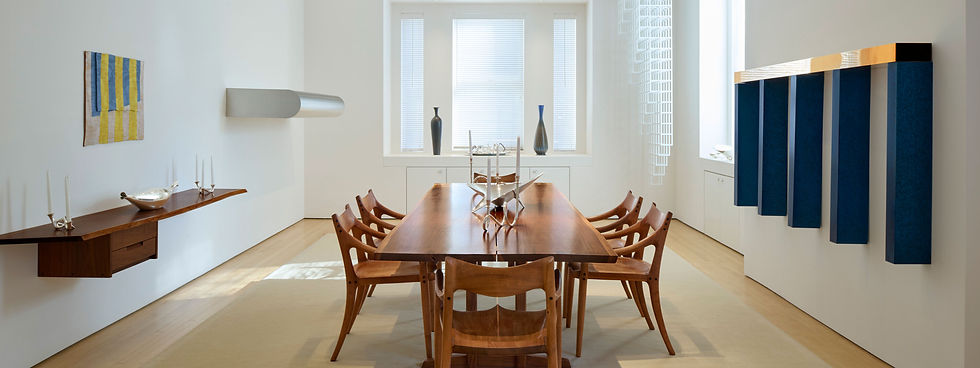
This may well be true, as the works from the McNeil collection, which are truly all of museum-grade quality, demonstrate the full aesthetic potential of Minimalism. His exceptional pieces by Donald Judd and Carl Andre manage to generate beauty by revealing the properties of materials, plain and simply as they are. Paradoxically, through their direct engagement with materiality, the artworks merely exist relationally, as they phenomenologically interplay with their surroundings. The 66 Copper-Carbon Corner artwork by Carl Andre, for instance, not only reflects the floorboard in a manner that makes it seem as though it were floating—it also echoes its own presence in space by casting reflected light into the surrounding walls. It is precisely those relationships with its environment which makes the artwork’s own aesthetic qualities emerge.

As for Donald Judd’s stack, the way its casts its copper and red fluorescent shadows on the wall is a thing of beauty in itself. On the other end, Fred Sandback’s 1969 Untitled (LLR of A Series of Eight Sculptures, Open Series) stands out for its ability to generate a dialogue with space through an economy of means.

Although usually associated with Minimalism, Sandback went once step further than his peers in terms of abstraction by radically dematerializing sculpture. Instead of presenting solid industrial volumes like Judd or Andre, he used coloured acrylic yarn installations to define virtual forms in space, requiring the viewer to mentally complete the sculpture. The artist himself explicitly asserted wanting “the volume of sculpture without the opaque mass.” As for the 1967 work 10th Cloth Octogonal by Richat Tuttle, it introduces fragility, asymmetry, and a more intimate scale into an art movement often associated with industrial rigor. Interestingly, the inclusion of works by Sandback and Tuttle, that art historians sometimes describe as a transition toward Post-Minimalism, subtly distances the collection from a purely orthodox reading of Minimalism. The full auction catalogue hence reveals that McNeil was less concerned by Minimalism as a strict historical category, than collecting artworks concerned with material clarity, spatial relationships, repetition, and lived experience.

Following the market’s growing appetite for tightly curated, single-owner collections, the McNeil sale arrives at a strategic moment. The art market’s downfall from late 2022 to 2024 is no news at this point; we have written extensively about it ourselves. Of all segments, ultra-contemporary art (made by artists born after 1974) has suffered the most during that time. According to the latest Artnet Intelligence Report, the sales revenues from ultracontemporary art reached $229.9 million in 2025—a -26.5% decrease compared to 2024. In recent seasons, it was clear that auction houses were focusing more and more on blue-chip art: both Christie’s and Sotheby’s increasingly relied on collections with strong narrative identities to anchor their marquee weeks, and one had trouble to find traces of any contemporary art in auction catalogues. The numbers don’t lie: this strategic shift paid off. According to the same report, fine art sales rebounded at auctions in 2025 with a sales revenue of $11.7 billion—+13.3% compared to 2024. And this progress was largely driven by the high-end segment. Indeed, the sales revenue generated by lots worth more than $10 million reached $2.3 billion in 2025—a +36.1% increase year over year.
The market at auctions is thus steering away from speculation and going back toward canonical postwar art—precisely where Minimalism sits. Expected to exceed $30 million, the McNeil Collection will headline Christie’s May sales in New York, beginning with a dedicated evening auction of just 12 works—a format that signals both rarity and institutional-level quality. The segment of minimalism itself follows the art markets dynamics of historical art movements that have been around for decades—marked by scarcity and low volatility (slower appreciations or depreciations). Indeed, most museum-grade minimalist works are either part of top-tier private collections or in exceptional institutional contexts such as the Dia Art Foundation, the Museum of Modern Art or Tate Modern. As a result, the supply of major works remains extremely limited, and price formation occurs in an episodic rather than continuous manner—typically when rare, museum-quality pieces come to market. Unlike ultra-contemporary art, where liquidity is frequent but volatile, Minimalism operates on low volume but high conviction transactions. In this context, the McNeil Collection enters the market with a clear advantage: it combines rarity, coherence, and provenance—the three primary drivers of value in the current cycle.

However, it must be said that the market peak for Minimalism seems to have been reached over a decade ago. Since then, overall prices in the segment have slowly decreased over time. Take the prices for artworks by Donald Judd, for instance. The historic auction record for multiple stacks dates back to November 2012, when a red piece from 1989 reached $10.2 million at a Christie’s in New York. If in 2023, at the lowest of the lows on the overall art market, a multiple stacks sculpture managed to reach the fifth highest price achieved at auction for one of Judd’s works, it was priced at 8.5 million. So, 15% less than the auction record for these works, for a work that was arguably more beautiful. As for Judd’s historic auction record ($14.2 million), it can be traced back to 2013. Similarly, Dan Flavin’s own auction high was reached a while ago, in 2014, when another diagonal fluorescent sculpture similar to the one from the McNeil collection (from 1964 this time) was sold a little over $3.07 million. Things are comparable on Sol LeWitt’s market: if the auction high came in 2023 for an exceptionally rare piece (an outdoors sculpture which sold for 1.6 million), prices have been stagnant to say the least for the most part. The record highs for a wall drawing came in 2014 and 2015 for instance, and the record high for one the artist’s indoor structures dates back to 2007… Now think about this: if you look at both LeWitt’s and Flavin’s overall markets, only one artwork ever exceeded a million dollars at auction for the former, and only ten for the latter. That is a bewildering fact, considering we are talking about two leading figures of one of the most prominent movements of 20th century art.
One of the key questions going into the sale will hence be the performance of the top lot. The 1969 Donald Judd stack, estimated at $10–15 million, is positioned just below the artist’s auction record. For it to reset the market, bidding would need to push past the $10.2 million achieved in 2013 by a similar work. A result within estimate would hence confirm such an upturn, and a result above would signal renewed depth at the very top end of the market for Minimalism. The Flavin diagonal sculpture will be another great indicator, as these early fluorescent pieces rarely come to market. Its result will hence give a clear sense of current demand—and the extent of the collector base—for early, historically significant works of Minimalism.
It is no news that art appreciation and depreciation follow trends and cycles. Minimalism is no exception, and it could make a comeback. However, for such a trend to last, one would have to envision the next generations of collectors acknowledging the aesthetic value of minimalist works in a market that is more international than it has ever been. In short: will future Asian millionaires ever collect the great names of an essentially American art movement? In reality, early signals suggest that the answer may not be entirely negative. Over the past decade, collectors from China and, more broadly, Asia have progressively moved beyond a purely domestic focus toward internationally validated, museum-grade works. While their activity has historically concentrated on blue-chip names in Impressionism, Modern art and, more recently, ultra-contemporary Western artists, there is growing evidence of a gradual shift toward postwar canonical movements. This shift is not purely aesthetic—it is also structural. As collections mature, there is a tendency to move away from speculative segments, toward works that offer stronger historical anchoring and institutional recognition. In that sense, Minimalism presents a compelling proposition as it combines global museum presence, and a finite supply of top tier works.

But even in terms of aesthetic inclinations, it would be ill-informed to assume that Asian audiences are not receptive to the intellectual and formal questions that gave rise to Minimalism. China itself has a few prominent artists that operate based on similar concerns, even if they do not produce minimalist art. Such is the case of Xu Zhen, for instance. Removing singularity and emphasizing serial production, his art tends to neutralize the expressive or symbolic charge of individual objects, redirecting attention toward their arrangement, scale, and spatial presence—an approach that echoes many principles of Minimalism. But this sensitivity is perhaps most clearly articulated in Asia through the art movement Mono-ha, which, in the late 1960s, developed a rigorous engagement with material, space, and perception comparable to that of Minimalism.

This is why we believe Minimalism is far from having said its last words, and that we are likely to see the segment find new momentum in the coming years—especially given the current reappreciation of canonical art in the face of wavering ultracontemporary trends. Who knows, maybe the McNeil collection will even be the beginning of the next upturn…


Comments